Oura Ring sleep data

Oura Ring sleep data: what it shows and how SomnoRoute may use it.

Oura can provide wearable-estimated sleep timing and stages, daily sleep and readiness summaries, heart-rate context and a nightly average SpO2 where the ring recorded, processed and synced those fields. SomnoRoute's private-beta Oura route is designed to import only data the user permits and to keep it separate from SomnoRoute-recorded evidence.

Product author: Mark McEnroe, SomnoRoute founder and product owner. Source review: SomnoRoute Editorial Team, updated 2 August 2026. Independent clinical review of health-context wording is pending. Oura values are supporting context, not a diagnosis or a replacement for a clinical sleep assessment. Read our editorial standards.

Data explained

What an Oura connection can contribute.

The exact fields depend on Oura consent scopes, the data recorded for that night and successful synchronisation. A report should show missing coverage rather than fill it with an estimate.

Sleep timing and stage estimates

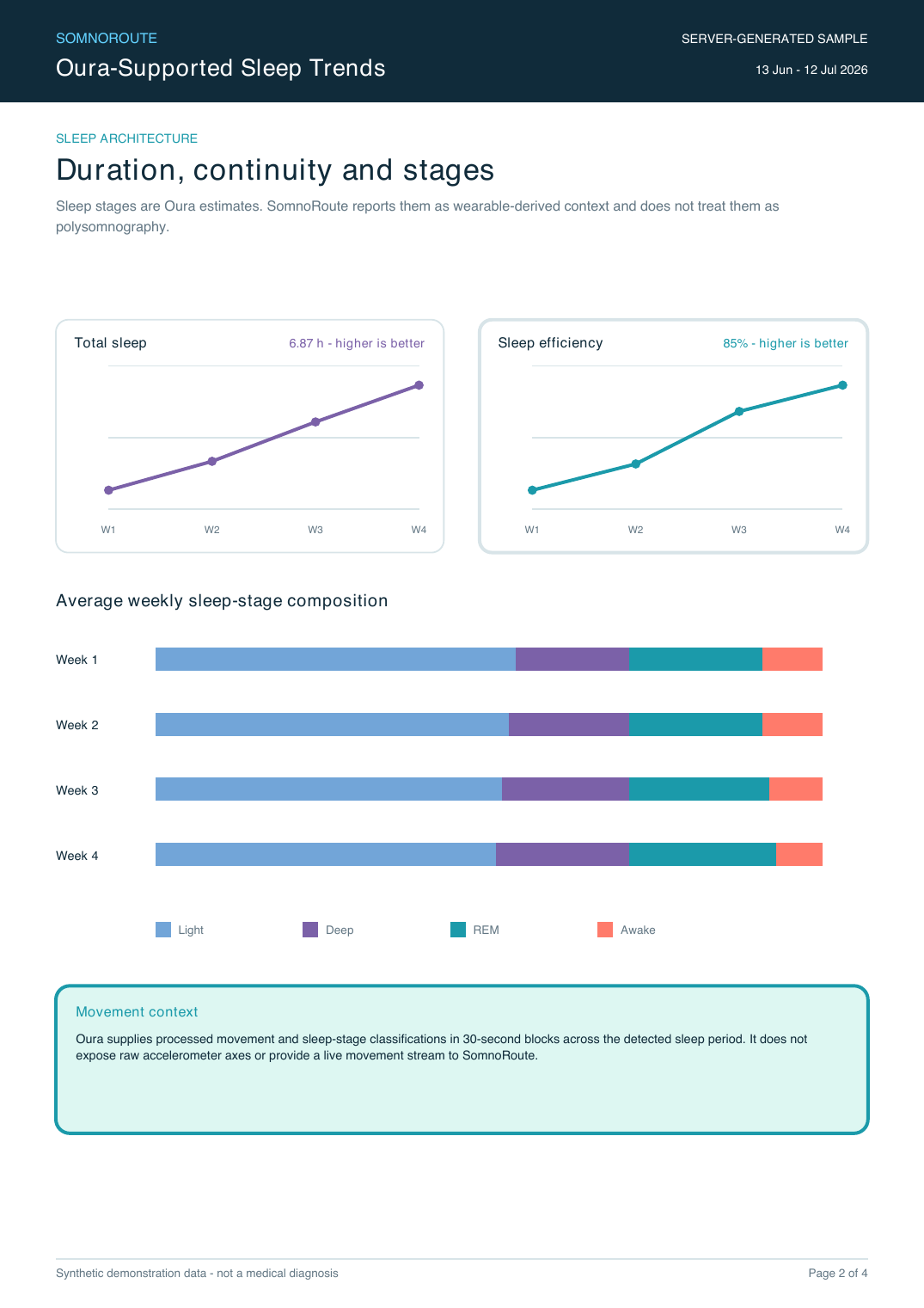
An Oura sleep document may contain bedtime start and end, total sleep, time in bed, awake time, latency, efficiency and estimated light, deep and REM sleep. These are wearable estimates rather than sleep stages measured by polysomnography.

Daily sleep and readiness summaries

Daily sleep and readiness scores can make a longer-term pattern easier to scan. They are Oura-generated summaries with their own contributors; SomnoRoute should identify them as Oura scores rather than relabelling them as SomnoRoute findings.

Heart rate, HRV and respiratory rate

Where present, overnight heart rate, heart-rate variability and average respiratory rate can describe physiological context. A change beside a noisy or restless period does not show that one caused the other.

Nightly average SpO2

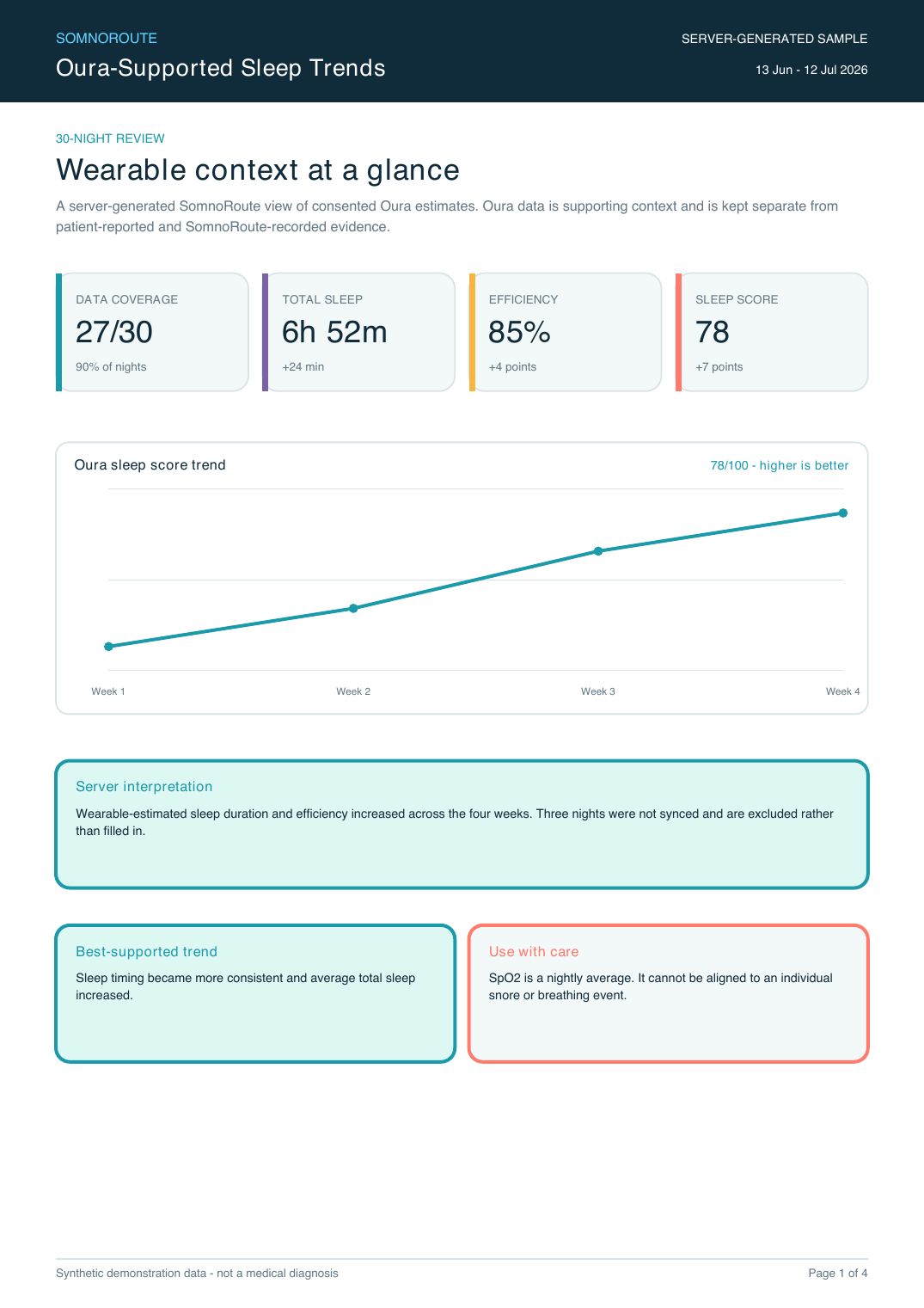
Oura's API can provide a daily SpO2 average when the relevant scope and data are available. SomnoRoute treats that as one whole-night summary: it is not an oxygen waveform and cannot be aligned to an individual snore or breathing-pattern event.

Coverage and source matter

A low ring battery, a short sleep period, a delayed app sync or a field that was not authorised can leave gaps. The useful report behaviour is to label the source and coverage, exclude missing nights from a trend and avoid implying that absent data was normal.

What the private beta is testing

SomnoRoute has a private-beta connection route for consented Oura sleep, daily summary, SpO2 and heart-rate data. Access depends on the beta build and a successfully configured Oura connection; SomnoRoute is not yet available for general app-store download.

SomnoRoute product evidence

See how source, coverage and Oura estimates are kept visible.

These are genuine screenshots from a server-generated SomnoRoute report using clearly labelled synthetic demonstration values. They show the intended private-beta report structure, not a patient result, Oura endorsement or clinical-validation study.

Open the four-page synthetic report PDF Made-up values • source labels • coverage limits • no diagnosis

What the screenshots demonstrate

The report separates evidence from interpretation.

  • Oura-derived values remain identified as Oura estimates.
  • Missing nights are excluded and counted instead of being filled.
  • A nightly SpO2 average is not aligned to individual sound events.
  • The footer states that the example is synthetic and non-diagnostic.

Read the full report interpretation guide

Permission and privacy

The connection should remain optional and reversible.

Explicit Oura consent

Oura's Cloud API uses OAuth 2.0 and requires the member to approve requested data scopes. SomnoRoute should receive only the scopes accepted for that connection.

Synchronisation is not continuous proof

Oura explains that sleep data becomes available to its API after the member opens the Oura app and syncs the ring. A delayed sync can therefore make a recent night appear incomplete.

Missing data stays missing

If a category was not permitted or the device did not record it, SomnoRoute should label it unavailable. It should not infer a normal value or reconstruct a clinical signal.

Disconnect and deletion choices

The private-beta design includes a disconnect route. Users should also be able to revoke Oura access and use SomnoRoute's privacy and account-deletion routes for data held by SomnoRoute.

Useful limits

What this data can and cannot answer.

Useful for repeated-night context

Comparable nights may help a user notice changing sleep timing, coverage, Oura scores or biometric context. The value is in describing a pattern and the conditions around it, not chasing one isolated number.

Not a cause-and-effect test

Oura and SomnoRoute observations cannot establish that snoring caused a heart-rate, HRV, respiratory or oxygen change. Separate clocks, algorithms and missing samples make event-level claims especially unsafe.

Not a diagnosis

Neither an Oura trend nor a SomnoRoute report can confirm or rule out sleep apnoea, insomnia or another medical condition. Concerning symptoms belong in a conversation with a qualified healthcare professional.

Questions

Oura Ring sleep data FAQ.

Does SomnoRoute need Oura to record the night?

No. Oura context is optional. The core SomnoRoute overnight route should still work when an Oura connection is absent, revoked or missing data.

Can an Oura score diagnose a sleep problem?

No. Scores and stages can support trend review, but they do not diagnose a condition or replace a professional assessment or formal sleep test.

Why might an Oura night be missing?

Possible reasons include incomplete recording, low battery, an unsynchronised ring, a short sleep period, unavailable API data or a permission that was not granted.

Where can I see a report example?

Open the Oura report-context guide to see a clearly labelled synthetic SomnoRoute report and the limits printed beside its trends.

Primary sources

Official documentation used for this guide.

Oura Cloud API

Oura API V2 documentation describes OAuth consent, available data scopes, daily sleep and readiness summaries, heart-rate data, nightly average SpO2 and synchronisation behaviour.