Oura Ring report interpretation

How to read Oura Ring trends inside a SomnoRoute report.

This page is about interpretation: start with coverage, keep Oura estimates separate from SomnoRoute-recorded evidence, and look for repeated context rather than a diagnosis. For definitions of the fields themselves, use the Oura Ring sleep-data guide.

Product author: Mark McEnroe, SomnoRoute founder and product owner. Source review: SomnoRoute Editorial Team, updated 2 August 2026. Independent clinical review of health-context wording is pending. The public example below uses synthetic demonstration data and is not a patient report or clinical-validation result. Read our editorial standards.

Product evidence

See the intended Oura-supported report format.

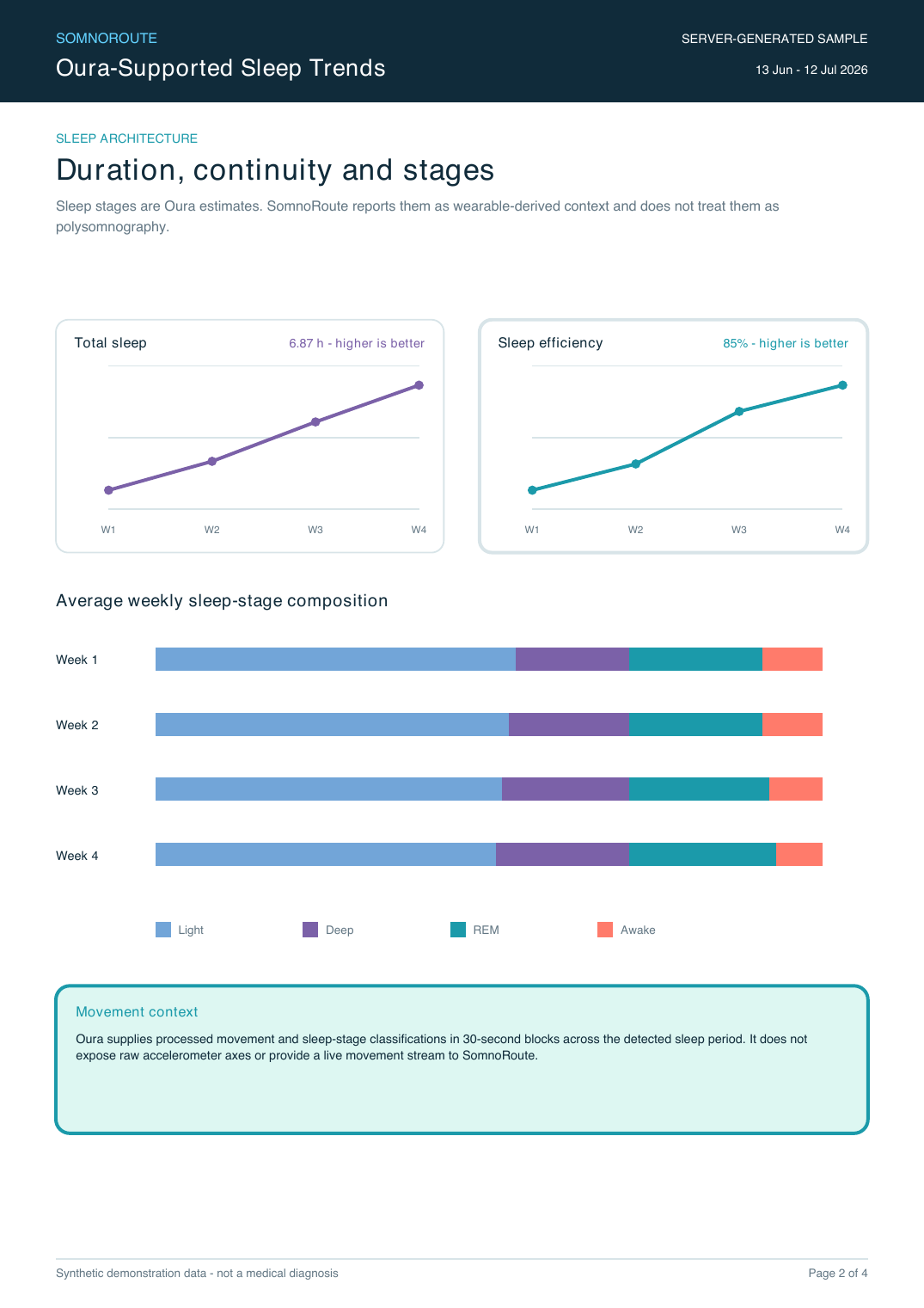
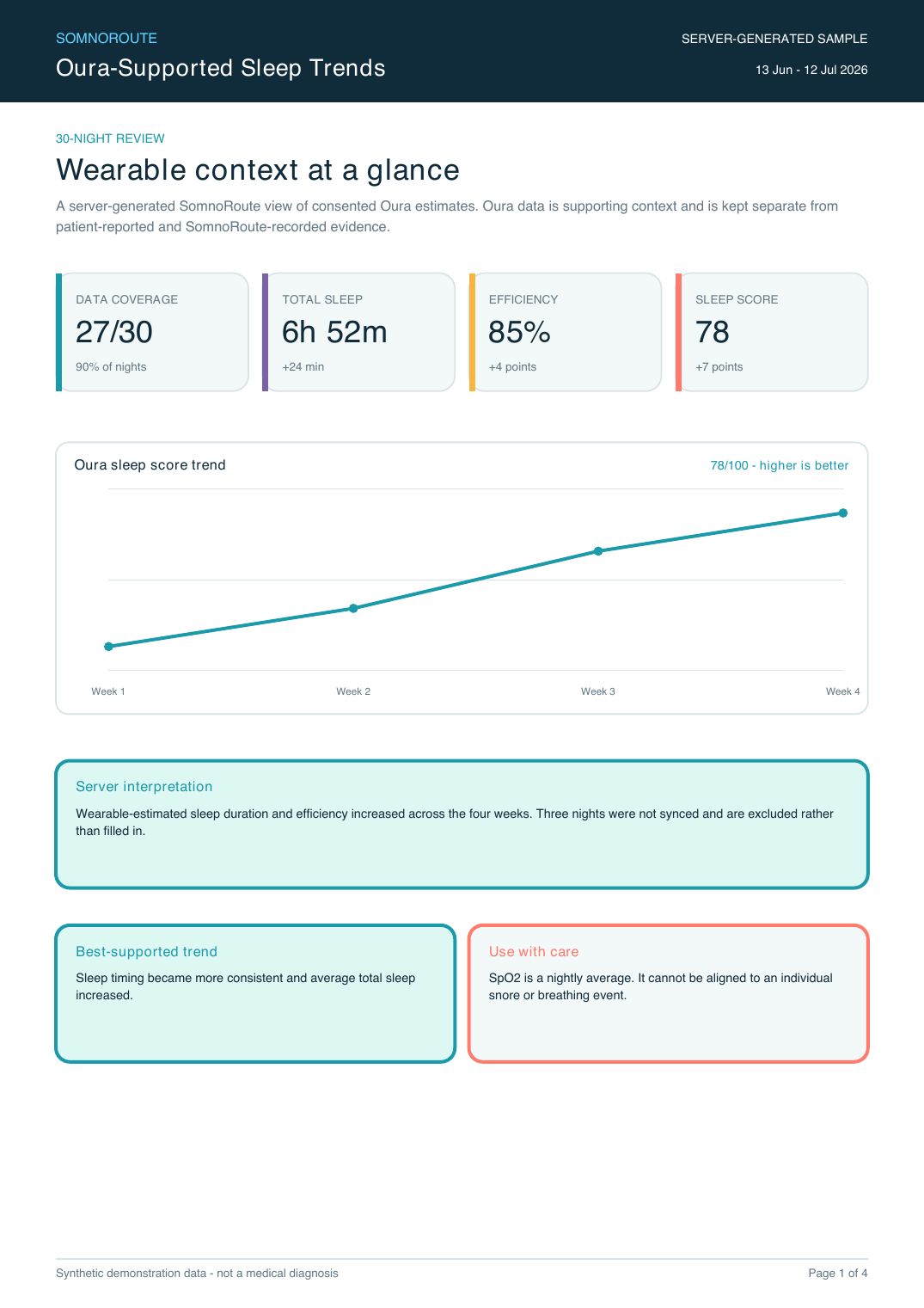
The sample is server generated from made-up values. It demonstrates source separation, data coverage, trend summaries and visible limitations; it does not demonstrate clinical accuracy.

Page 1 of a synthetic SomnoRoute Oura-supported sleep trends report showing coverage and trend context Page 2 of a synthetic SomnoRoute report showing Oura-estimated sleep duration, efficiency and stage trends
Synthetic report example

Oura-supported sleep and recovery trends.

The four-page demonstration covers sleep timing and stages, heart rate, HRV, respiration, nightly average SpO2, data coverage and wearable limitations. All values are invented for layout demonstration.

Open the example PDF

Reading order

Four checks before interpreting a trend.

1. Check the date range and coverage

Confirm how many nights were expected, how many synced and which were excluded. A trend based on 27 of 30 nights means three nights are unknown, not automatically typical or problem-free.

2. Identify the source of every value

Oura sleep stages and scores are Oura estimates. Phone-recorded sound and SomnoRoute event summaries come from a different route. Notes come from the user. They should remain labelled rather than blended into one unexplained result.

3. Compare like with like

Look across broadly comparable nights and note travel, illness, alcohol, medication changes, late routines, device fit or incomplete recording. A change may be worth describing without establishing its cause.

4. End with a factual summary

State what repeated, what changed, what was missing and how you felt. A concise factual summary is more useful for a professional conversation than turning an app score into a conclusion.

Metric limits

Read each Oura field at the right level.

Sleep score and readiness

These are Oura-generated daily summaries. They can help scan a repeated trend but are not SomnoRoute diagnoses, clinical severity scores or proof that one recorded behaviour caused another.

Sleep duration and stages

Use these as wearable estimates and keep the source label visible. They should not be relabelled as polysomnography or used to claim that a condition has been confirmed or excluded.

Heart rate, HRV and respiration

These may add night-level physiological context where coverage is available. A simultaneous or nearby change is an observation, not evidence of cause.

Nightly average SpO2

This is a whole-night average supplied through Oura's data route, not a continuous waveform. It cannot be safely aligned to an individual snore or breathing-pattern event, and it is not clinical AHI or ODI.

Different search intents

Choose the Oura guide that answers your question.

Need to understand the data?

The Oura Ring sleep-data guide explains available fields, OAuth permission, synchronisation, missing coverage and the private-beta connection boundary.

Need to understand the report?

Stay on this page for the reading order, synthetic product example and the limits that should appear beside Oura-supported trends.

Questions

Oura-supported report FAQ.

What should I check first?

Check the reporting period, data coverage, excluded nights and source labels before reading a trend. Missing Oura nights should not be filled or treated as normal.

Can a nightly average SpO2 be matched to a snore event?

No. A nightly average is a whole-night summary, not a continuous oxygen waveform. It cannot safely be aligned to an individual snore or breathing-pattern event.

Are Oura sleep stages clinical sleep stages?

No. Oura stages are wearable estimates. A SomnoRoute report should identify them as Oura estimates and keep them separate from formal polysomnography.

Does the sample contain real user data?

No. The public Oura-supported report uses synthetic demonstration data. It shows intended structure and limitations, not a patient result or clinical-validation study.

Primary sources

Official Oura documentation used for this guide.

Oura Cloud API

Oura API V2 documentation describes OAuth consent, Oura data scopes, sleep and readiness summaries, nightly average SpO2 and data synchronisation.